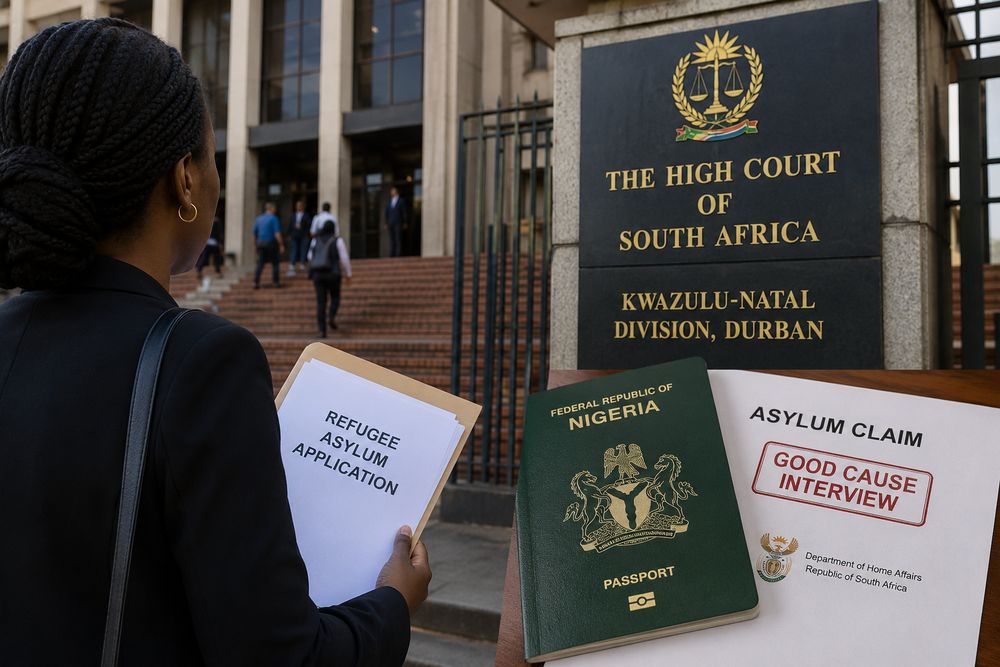
Home Affairs ordered to provide Nigerian woman refugee interview despite deeply flawed papers
The KwaZulu-Natal High Court in Durban ordered the Department of Home Affairs to give a Nigerian woman an opportunity to attend a “good cause” interview to pursue her refugee claim, while sharply criticising her legal representatives for submitting what the court described as a deeply flawed application riddled with factual errors, inconsistencies and poor drafting.
Judge Malcolm Wallis ruled that Home Affairs must, within 60 days, provide Chetachi Christie Uduogu with a good cause interview before the department’s Immigration Services Inspectorate.
Uduogu, a Nigerian citizen seeking refugee status in South Africa, approached the court seeking an order compelling Home Affairs to grant her a good cause interview so that her asylum claim could be assessed.
By the time the matter was argued, Home Affairs had already agreed to an order substantially allowing the interview, leaving only the issue of costs for the court to determine. The judge nevertheless examined the merits of the application because of the unusual order ultimately granted against the applicant’s legal team.
The judgment contains extensive criticism of the papers filed on Uduogu’s behalf. Judge Wallis noted that the founding affidavit appeared to have been prepared using a template without being properly adapted to her circumstances.
Among the most glaring errors was a section headed “Conflict in Ethiopia,” despite the affidavit discussing unrest in Nigeria. The affidavit stated that Uduogu was born in Nigeria but claimed she had been the victim of war crimes committed by the Ethiopian military. When questioned during the hearing, her counsel was unable to explain how those contradictions had found their way into the court papers.
The court also found significant shortcomings in the factual detail supporting the asylum application. Although Uduogu claimed she arrived in South Africa by air in 2018, the affidavit failed to specify the date of arrival, the airport she entered through or the airline she used. It also did not include a copy of her passport.
The judge further questioned an unexplained statement that she had entered the country without a transit visa, observing that such a visa would ordinarily only be required where South Africa was not the final destination.
Judge Wallis found that the affidavit contained only broad generalisations about alleged persecution in Nigeria and failed to identify any specific incidents, the town from which she allegedly fled or why she could not seek safety elsewhere within Nigeria before leaving the country.
The court was equally critical of the explanation for why she had waited years before pursuing refugee status. According to the affidavit, she visited the Durban refugee reception office in March 2018 but was turned away because it was fully booked. She claimed she returned monthly and was repeatedly chased away before the centre later closed during the Covid-19 pandemic.
The affidavit further alleged that an application was submitted through a non-governmental organisation in February 2023, but no copy of that application or supporting affidavit from the organisation was provided. The judge also noted that nothing appeared to have happened between February 2023 and January 2026, when Uduogu said she was informed she first needed a good cause interview.
Another concern related to translation of the affidavit. Uduogu stated that her English was poor and that the affidavit had been translated for her. However, the court noted that neither the affidavit nor the interpreter’s certificate adequately identified the language from which it had been translated.
While the interpreter certified fluency in languages including Swahili, French, Kirundi, Lingala and Kinyarwanda, the papers failed to establish that Uduogu herself was sufficiently fluent in any of those languages or that the translation process had been properly conducted.
Despite these shortcomings, the judge recognised the special position occupied by asylum seekers and noted that Home Affairs had acted appropriately by agreeing to facilitate the interview.
Judge Wallis said the application would likely have failed had it not been for the Home Affairs’ consent and the special circumstances surrounding refugee matters. He also observed that Uduogu had not been well served by her legal advisers.
The court pointed out that Uduogu’s attorneys had previously been criticised in an earlier judgment involving similar defective applications yet had failed to improve the quality of their work.
As result of the flawed application, the court made no costs order between the parties and went a step further by ordering Uduogu’s attorney and counsel not to recover any fees for the case and must refund any money she has already paid them.
[email protected]
IOL News